An excerpt from Travels with the Muse: A Creative Pilgrimage by Lori Erickson
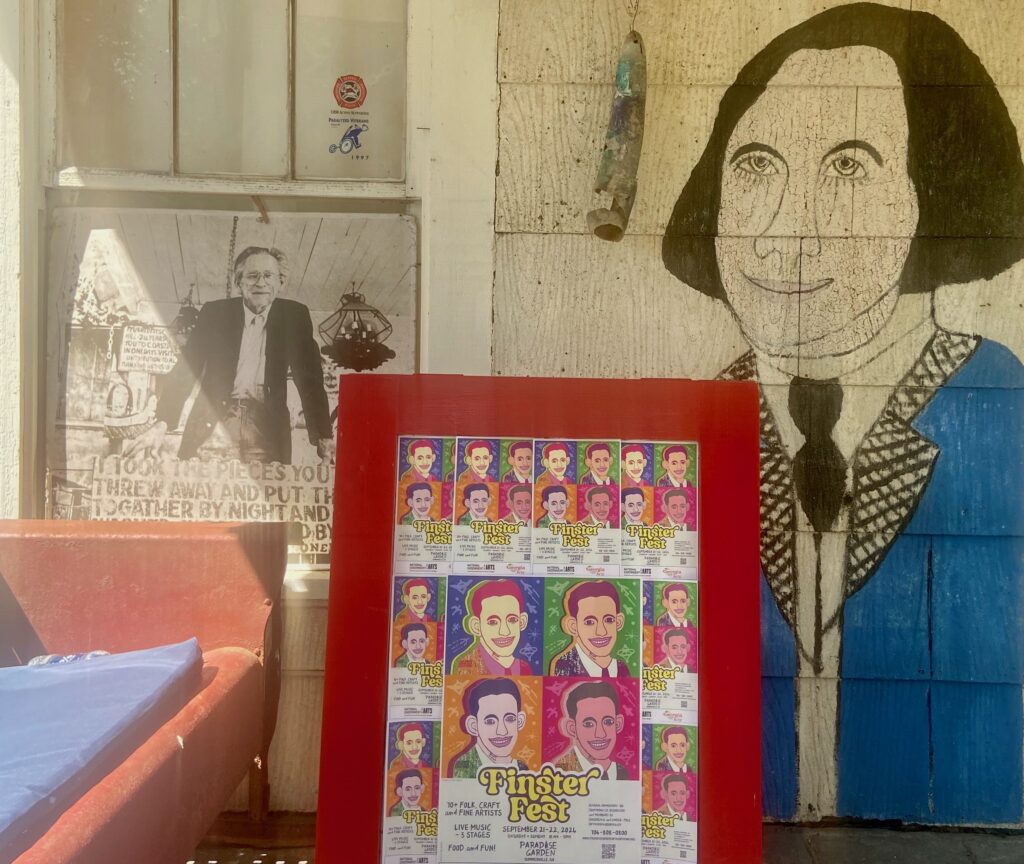
God’s Junkyard
My first indication that I wasn’t headed to your typical genteel art fair came as I stood in line in a Walmart parking lot in a small town in Georgia, waiting to board a shuttle that would take me to the grounds where Finster Fest was being held. An elderly man in a beat-up car pulled up beside the line and thrust a photograph out his open window, a grainy black-and-white image of several people standing knee-deep in a river.
“That’s Reverend Howard baptizing me when I was fourteen,” he said, obviously pleased to be associated with a local celebrity. “He was my pastor. I knew him before he was famous.”
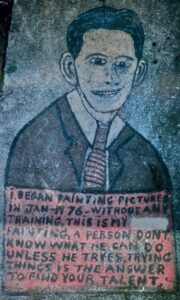
After admiring the photo, I asked what the locals think of Howard Finster’s art. “When he was alive, a lot of folks just thought he was crazy, and there’s still people who think Paradise Garden is a junk yard,” he said. “But people come from all over the world to see it, and we’re proud of Howard now.”
If you’re interested in outsider art, sooner or later you’re likely to find your way to Finster Fest, held each September in Paradise Garden, a four-acre landmark created by Howard Finster near the town of Summerville. The event celebrates not only his artistic legacy, but the wider world of folk and outsider art that continues to flourish far from museums.
As my translator for Southern culture, I took along my friend Virginia, a native of neighboring South Carolina. “It’s too bad it’s so hot,” I told her as we boarded the shuttle to the festival grounds.
“This isn’t hot,” she said. “This is barely even sort-of-warm by Southern standards. You don’t know hot until you’ve been here in the summer.”
A short ride brought us to Paradise Garden, which Howard designed and built over a twenty-year period. While he had tinkered with art in his Plant Farm Museum in Trion, Georgia, after he and his family moved to this piece of land near Summerville in 1961, his creative efforts intensified. The property would become his magnum opus, an immersive art environment that blended evangelism and his quirky, chaotic creativity.
After paying a small admission fee, we entered Paradise Garden, which buzzed with conversations among the hundreds of people wandering its grounds. When the aroma of barbecued pork drifted from a nearby food tent, I told Virginia this was exactly how I imagined Paradise smelling.
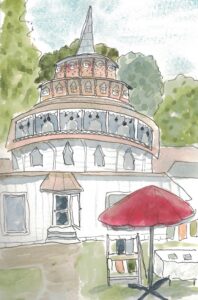
Still, the real feast here was artistic. Nearly eighty artists had set up booths to sell their work amid the fantastical environment Howard Finster had created, with its sculptures, paintings, murals, and ramshackle buildings all stitched together by winding mosaic pathways. Everywhere I turned, there was something new to take in. In one corner stood a garden overlooked by a tiny house on stilts, its exterior covered in mirrors. In another, a long, narrow building displayed hundreds of paintings by a multitude of artists, their work ranging from the kitschy to the profound. Hand-painted Bible verses adorned many surfaces, surrounded by a riot of characters who included prophets, presidents, angels, extraterrestrials, and, of course, Elvis. Presiding over it all was the World’s Folk Art Chapel, a wedding-cake-of-a-building crowned with a tiered tower.
Howard’s voice was everywhere, delivering emphatic pronouncements in capital letters. In one building, for example, a plaque bore this poem:
AS THE STREAM OF LIFE RUNS THROUGH MY SOUL
THE LORD HAS GIVEN ME A PEEPING HOLE.
WHERE I CAN SEE LIGHT ON THE DARKEST TRAIL.
ALL THE WAY TO HEAVEN OR HELL.
HEAR ME STRAIGHT DON’T BE LATE.
I WILL LOOK FOR YOU AT THE PEARLY GATE.
Painted on the side of a camper that had clearly seen better days was another message:
TIME WAITS FOR NO ONE.
BE READY WHEN GOD CALLS.
TAKE TIME TO BE HOLY.
I NEVER SEEN A PERSON I DIDN’T LOVE.
Howard Finster had been dead for more than two decades, but as I made my way through his vision of heaven, I felt as if he were right there with me.
The artists selling their wares were an equally unconventional lot. I was drawn to Becca Cook’s booth by a hand-lettered sign for UFO Studio advertising “good vibes, psychic readings, alien sightings, eye phone repair, biblically accurate angels, and bad advice.” Inside, I lingered over her brightly colored paintings, crowded with fantasy creatures and esoteric symbols.
“I’m a visionary artist, like Howard Finster was,” she told me. “I love how he set an example for how to be who you are and follow your own inner light.”
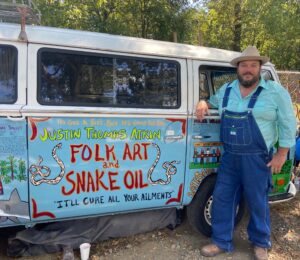
I also enjoyed visiting with Justin Thomas Atkin, who was selling both paintings and his own brand of corn grits. The sign outside of his booth announced that he would trade grits and art for a long list of items that included camping gear, old coins, and cowboy boots (“size 10 ½ – 11 and preferably Justin or Tony Lama but I ain’t picky”). His VW van, which was parked next to his booth, had “Folk Art and Snake Oil: It’ll Cure All Your Ailments” emblazoned on its side.
“I don’t do this for the money,” Justin told me. “I just sort of got to get it out. After I started painting, people told me my work reminded them of Howard Finster’s. It tells stories, and I’m self-taught, just like he was. If you can’t draw and can’t paint, people call you a folk artist. That’s what I am.”
As I strolled past the booths, I was struck by how cheerful it all felt. The art was full of bold colors and playful images, and people’s lively conversations were threaded with the sounds of a fiddle and banjo playing somewhere in the distance. Passing a booth where the Chattooga Garden Club was selling pimento cheese sandwiches and banana pudding, I spotted Virginia deep in conversation with another woman. As I drew closer, I could hear the two of them swapping childhood stories with the easy familiarity of people who seemed to have known each other for decades.
“People are friendlier in the South,” I told Virginia as we walked away together.
“I miss that in Iowa,” she said. “On the other hand, it doesn’t take nearly as long to do errands.”
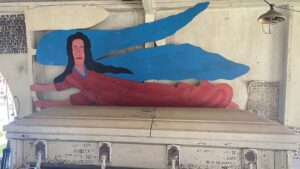
Together we headed to the Meditation Chapel, where a bluegrass band was performing on a makeshift stage that mysteriously held a battered white coffin, with one of Howard’s signature angels floating above it on the wall. As we settled into our seats, I fanned myself with my program, enjoying the music and the mix of people around me, who included artfully unconventional youth, overalled farmers, and smartly dressed women who looked like they hailed from the wealthier suburbs of Atlanta.
After the concert ended, we headed to another part of the garden to hear a talk by Steve Slotin, co-owner of Slotin Auction. He and his wife, Amy, began collecting folk art pieces in the early 1990s, igniting a passion that led them to organize a series of shows and sales (“Howard Finster used to come to our events and preach the entire time,” he recalls). Those efforts grew into an online auction business that’s now the largest dealer of works by self-taught artists in the United States.
Slotin explained that major museums began collecting the work of self-taught artists in the 1970s, and in the next decades interest exploded. While outsider art can be found across the country, he noted that the South remains its Ground Zero, in part because of the region’s appreciation for eccentricity.
During the question-and-answer period I asked him why he thought religious themes tend to be so prominent in folk art. He said that in the past, the Bible was one of the few books people had in poor, rural areas of the South, and it’s not surprising that it shaped the creativity of artists. While Howard Finster is on the outer extreme of creating spiritually infused art, he is far from unique.
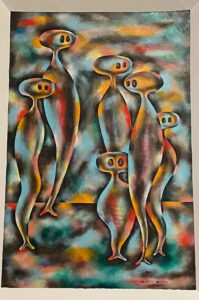
Slotin ended his talk with some advice. “People always ask me, ‘What should I buy?’ My answer is always the same: buy what you like. Don’t think of it as an investment. Support the artists and enjoy the art.”
His talk left me thinking about the ethical tensions that surround outsider art. Many self-taught artists live with serious hardships, and their distance from the art world leaves them vulnerable to exploitation. Even when dealers act in good faith, artists are typically paid only once, at the moment of sale. If a work later becomes highly valued, the artist who created it rarely shares in the profits from its resale.
Forgery is another concern. As interest in self-taught art has grown, so has the incentive to imitate the distinctive styles of well-known artists. Because many of these people did not document their work systematically, questions of authenticity can be difficult to resolve. With no central authority to certify outsider art, responsibility often falls to individual experts, dealers, and collectors to decide what is genuine.
But for Howard Finster, at least, art was his gateway to national acclaim and greater financial security. As I looked around Paradise Garden, now a bit cooler as the heat of midday had eased, the fruits of his imagination were everywhere, from the sculptures made from discarded bicycle parts to the people selling and buying art, chattering all the while.
I strolled through the grounds, eventually ending up in a building that was playing a documentary about his life. My favorite scene was from his 1983 appearance on The Tonight Show. I watched as he came onto the stage, a little nervous at first, then increasingly confident. He told Johnny Carson about his art, how he didn’t need much sleep and so could paint much of the night and then work in his garden during the day. A brief clip showed him walking hand in hand with his young grandson through the grounds, which looked much the same as they do today.
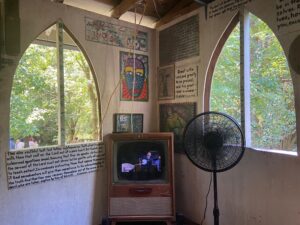
After the clip, Johnny mentioned that he’d heard Howard also wrote songs. Clearly ready for his cue, Howard reached behind his chair, grabbed his banjo, leapt to his feet, and began striding across the stage, singing an infectious tune. The audience started to clap along, and somehow the bright notes of the banjo and the twang of Howard’s voice carried the anarchic, sweet spirit of Paradise Garden all the way into that Hollywood studio.
I’m not sure how many people Howard converted to Christianity, but he was a powerful evangelist for living with joy.
Curating the Unconventional
Museums have played a central role in raising the profile of outsider, self-taught, and folk art. Some make it their central mission, such as the American Visionary Art Museum in Baltimore and Chicago’s Intuit: The Center for Intuitive and Outsider Art. Others hold substantial collections, including the Smithsonian American Art Museum in Washington, D.C., the High Museum of Art in Atlanta, and the American Folk Art Museum in New York.
I was pleased to learn that one of the major centers for outsider art, the John Michael Kohler Arts Center, is a half-day’s drive from my home. Its main building is in downtown Sheboygan, Wisconsin, with a satellite campus called the Art Preserve a few miles away.
When a friend heard I was going to visit these sites, he offered his opinion of both the museums and the entire state. “I’m not surprised they’re in Wisconsin, because it’s a weird place,” he said. “Weird in a good sort of way, but still weird. It’s not just those big cheeseheads people wear at Green Bay Packers football games. Maybe it’s something in the water there.”
That opinion certainly seemed justified when Bob and I entered the John Michael Kohler Arts Center. Needing to use the bathroom after our drive, I was surprised to discover that nearly every inch of the women’s restroom was filled with art. An idiosyncratic array of female figures, animals, and accessories covered its ceramic surfaces—even the insides of the toilet bowls were ornamented.
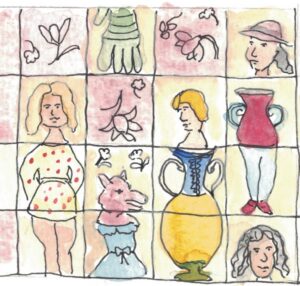
“You won’t believe what it looks like in there,” I told Bob as I exited.
“You should see the men’s,” he replied.
Standing guard for each other, we took turns peeking into the other restroom. The men’s bathroom was also an art gallery, though rendered in a blue-and-white color palette reminiscent of Delft ceramics. Water was the theme, with tiles, counters, and toilets bearing images of swimming pools, car washes, and views of Lake Michigan. Once again, I thought of Marcel Duchamp’s 1917 urinal sculpture. While I couldn’t quite see that piece as a work of art, the urinals in the Art Center definitely fit the bill.
The woman at the front desk smiled as we approached. “Those washrooms are something, aren’t they?” she said, then explained that the women’s restroom was designed by Cynthia Consentino and the men’s by Ann Agee.
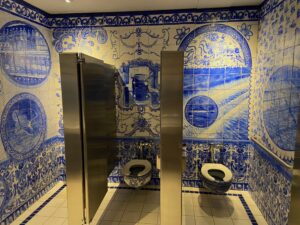
Those artistic bathrooms aren’t a random flourish. John Michael Kohler founded the Kohler Co., a plumbing fixture manufacturer, in 1873. Years later, his heirs deeded the land on which the Arts Center was built. Their bathrooms grew out of the Arts/Industry residency program, a long-standing collaboration between the center and the company that has hosted more than six hundred artists. Given access to industrial materials and processes, these artists reshape the everyday forms of plumbing into something surprising. So if you’ve ever installed a Kohler toilet in your home, consider yourself a patron of the arts.
Bob and I enjoyed browsing the main museum, which houses a collection of contemporary art and hosts rotating exhibitions, community programs, and arts education offerings (along with more artistic bathrooms). But our primary destination was the Art Preserve, which opened in 2021 as the world’s first museum dedicated to artist-built environments, with an emphasis on those created by self-taught artists. These works aren’t just individual paintings or sculptures—they’re art-filled rooms and, in some cases, entire houses. Most were made by people who started creating and simply couldn’t stop. In short, it’s a museum devoted to the Howard Finsters of the world.
The Art Preserve’s architecture reflects its mission. Located on a thirty-eight-acre wooded site, it’s constructed of elemental materials—concrete, wood, and weathered steel—that echo the humble substances often used by outsider artists. Large windows frame views of the surrounding landscape, and expansive interior spaces accommodate its monumental works. Across three floors, the exhibits show how self-taught, folk, and visionary artists transformed their inner worlds into immersive environments.
If traditional art museums can sometimes feel like they’re doing you a favor by allowing you through the door, the Art Preserve is more like your reclusive neighbor who’s obsessed with aliens and is happy to take any junk off your hands for his latest creation.
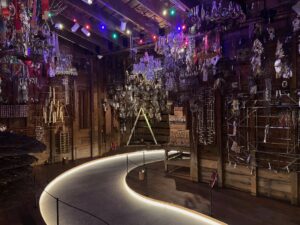
One of the most striking installations is Emery Blagdon’s Healing Machine, created between 1956 and 1986 on his small farm in Nebraska. After losing several close family members to cancer, Blagdon set out to build a space that could harness earth’s energies for healing. Today, the work is housed in a shed-like structure that recreates its original setting. Dimly lit, it contains hundreds of intricate, mobile-like sculptures made from wire, tin foil, ribbons, beads, magnets, and other miscellany hanging from the ceiling. The overall effect is mystical and unsettling, like walking through a dream that’s taken solid form.
Another installation preserves the work of Eugene Von Bruenchenhein, who transformed his modest Wisconsin home into what he called a House of Visionary Wonders. His output included vividly colored paintings inspired by science fiction, photographs of his wife, Marie, and sculptures assembled from found materials—including, memorably, chicken bones. After touring the installation, I was reminded that art can be made out of almost anything.
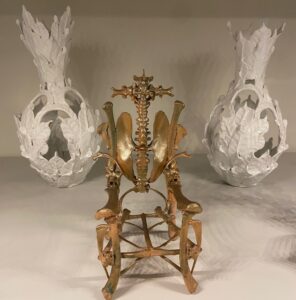
Von Bruenchenhein’s work played an important role in the founding of the Art Preserve. Ruth DeYoung Kohler II, who directed the John Michael Kohler Arts Center for more than four decades, first encountered his work shortly after his death. Visiting his home, she was astonished by the scope and power of what he had created. She later wrote that wandering through the house left her completely overwhelmed (towers constructed from thousands of carefully cleaned chicken bones will do that to a person).
Recognizing that Von Bruenchenhein’s home was itself a complete art environment, the Art Center acquired thousands of his works, an act that helped inspire the creation of the Art Preserve. In combination with the museum, the Kohler Foundation, Inc. now works to restore and protect other artist-built environments in their original locations. Thanks to the leadership of these visionary toilet manufacturers from Wisconsin, the work of hundreds of artists has been saved and celebrated.
Messy, Imperfect, and Mine
More than any of the other art forms I’d explored, outsider art spoke to me. Its unruly menagerie took up residence in my imagination: Howard Finster’s floating angels, Judith Scott’s cocooned forms, the quiet dignity of William Edmondson’s gravestones. All reassured me that my own art didn’t have to be polished or sophisticated to matter. Even if no one else ever admired it, I could still claim the small, stubborn truth of being an artist—someone who gives form to what would otherwise remain unseen.
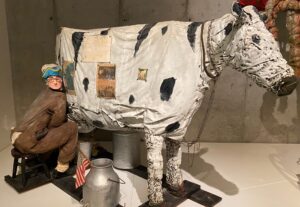
And while I’d long appreciated the authenticity of outsider art, it wasn’t until my visit to the Art Preserve that I understood how its imperfections often make the work stronger, not weaker. In the broken plates turned into mosaics, the scratched bottle caps used as decorations, and the portraits of people with proportions askew, I glimpsed hints of the Japanese philosophy of wabi-sabi, which teaches that imperfection is not a problem to be solved but a truth to be honored. Cracks are filled with gold, not erased; ordinary materials are honored rather than discarded. Both wabi-sabi and outsider art invite us to revise our ideas of beauty and examine more carefully what we are tempted to overlook.
And these, of course, are lessons for life itself. Our imperfections are not detours from beauty, but often the place where it begins.
Finally, I’ve also changed my definition of what it means to be good at art. It’s a bit of a sleight of hand, actually: I count a day as a success if I’ve done some art. It doesn’t have to be for long or be technically skilled. It just needs to be done, whether it’s a sketch of a window, a few details added to a painting from the day before, or five minutes of drawing wedged between errands as I sit in the car. This approach is unlikely to land me in a museum, but at the end of my life I hope to have something nearly as good: a tall stack of sketchbooks, proof that I kept trying.
It all makes me think of a sticker I saw on the back of a street sign outside of Paradise Garden: “What if Jesus was your art teacher?”
OK, I’ll take that hypothetical! I think Jesus as art teacher would be kind and encouraging, less “sell all you have and give it to the poor” and more “let the little children come unto me.” He’d admire each page in my sketchbook and point out where the shading was nicely done, and where I’d caught just the right angle of my cat’s head, and how it was just remarkable that I’d tried to draw something every single day.
Then he’d add, “And I really like how you’re trying to let the spirit shine through, no matter what you draw.”
__________________________________________
Excerpted from Travels with the Muse: A Creative Pilgrimage by Lori Erickson. Copyright © 2026 by Lori Erickson. Reprinted by permission of Spiritual Travels Press. All rights reserved.
Photographs and artwork courtesy of Lori Erickson and Bob Sessions.


Lori Erickson
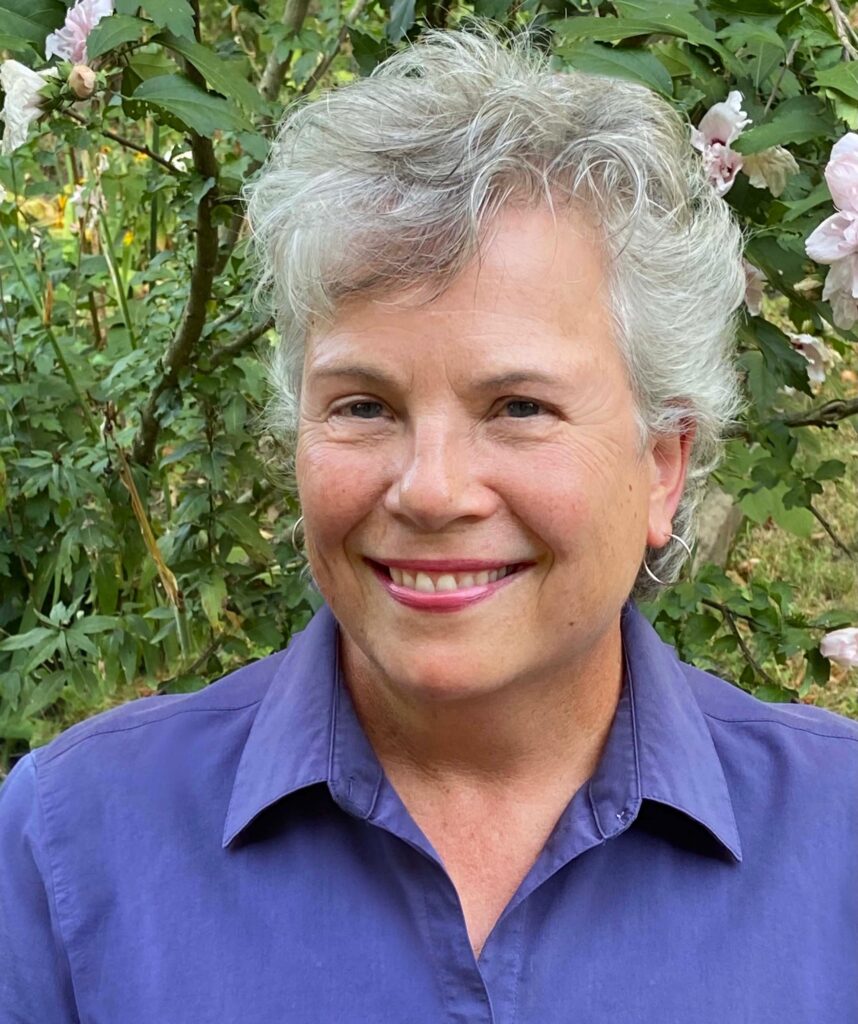
Lori Erickson is a writer who explores the intersections of spirituality, travel, and culture. Her latest book, Travels with the Muse: A Creative Pilgrimage, takes readers on a journey through the arts, from outsider art and sacred icons to blues music, sculpture, and architecture. Her previous books include Every Step Is Home, The Soul of the Family Tree, and Holy Rover. She lives in Iowa City, Iowa. Order a copy of Travels with the Muse here, and visit Erickson’s website here.